
Maximising Efficiency: How Manufacturing Units Can Benefit from Vertical Storage

Maximising Efficiency: How Manufacturing Units Can Benefit from Vertical Storage
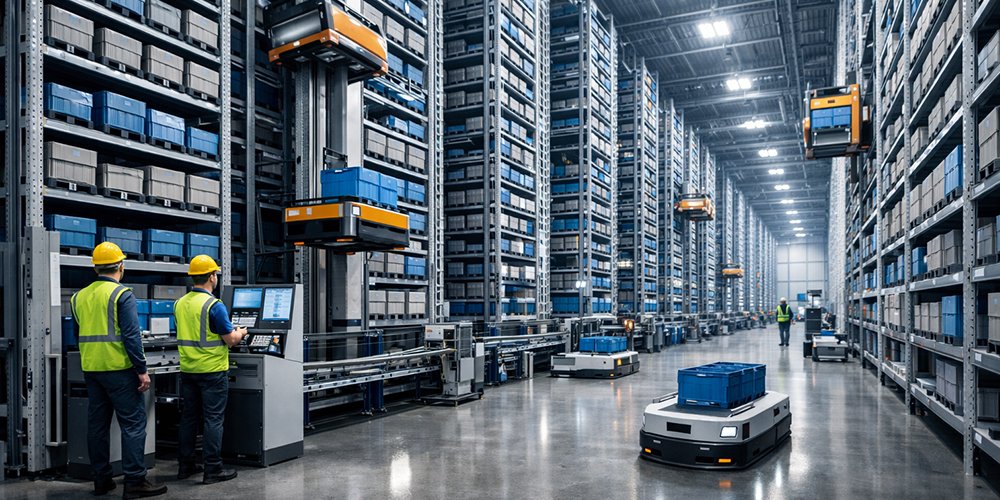
In the competitive landscape of modern production, the floor space of a factory is often its most valuable—and limited asset. As manufacturing units in India and across the globe strive for leaner operations, the shift from traditional horizontal racking to an advanced vertical storage system has become a game-changer.
If your facility is struggling with cluttered aisles, slow retrieval times, or a lack of floor space, it’s time to look up. Here is how manufacturing units can transform their operations using industrial storage solutions.
The Evolution of Space: Why Manufacturing Companies Use Vertical Storage
Traditionally, warehouses expanded by taking up more land. However, horizontal expansion is expensive and often impossible. Vertical storage for manufacturing leverages the unused overhead space, allowing factories to condense their footprint significantly.
By integrating a vertical lift module (VLM), companies can recover up to 90% of their existing floor space. This “recovered” space can then be used for additional production lines, quality control zones, or employee workstations, directly contributing to the company’s bottom line.
Top Benefits of Vertical Storage in Manufacturing Units
1. Optimised Space Utilisation
The primary driver for adopting automated vertical storage is space optimisation. Unlike static shelving, these systems reach toward the ceiling, utilising the full height of your facility. For companies looking for space-saving storage in manufacturing, this is the most effective intervention available.
2. Enhanced Productivity and Speed
In a traditional setup, workers spend 60-70% of their time walking and searching for parts. VLM benefits for factories include the “Goods-to-Person” principle. Instead of the operator going to the shelf, the system delivers the required item directly to an ergonomic access window at the touch of a button.
3. Inventory Accuracy and Security
Modern warehouse storage systems in India are now integrated with sophisticated software. Every part stored in a vertical module is tracked in real-time. This reduces “lost” inventory, prevents stockouts, and protects high-value components from dust, damage, and unauthorised access.
4. Improved Ergonomics and Safety
Safety is paramount in any industrial setting. Industrial storage solutions like vertical lifts eliminate the need for ladders, forklifts in tight aisles, and heavy lifting from high shelves. This reduces workplace injuries and fatigue, leading to a more motivated workforce.
Vertical Storage vs. Traditional Storage: The Comparison
Feature | Traditional Racking | Vertical Storage System (VLM) |
Space Usage | High floor footprint, wasted air space | Minimal footprint, uses full height |
Retrieval Speed | Slow (Walking/Searching) | Fast (Automated delivery) |
Accuracy | Prone to human error | High (Software integrated) |
Safety | High risk (Ladders/Forklifts) | Low risk (Ergonomic delivery) |
Protection | Exposed to dust and theft | Enclosed and secure |
Why TechMark is the Leader in Industrial Storage Solutions
As manufacturing in India moves toward Industry 4.0, having a partner who understands the local landscape is vital. TechMark provides cutting-edge vertical lift module benefits tailored to the specific needs of Indian factories.
Whether you are managing small electronic components or heavy automotive spare parts, Techmark’s automated solutions ensure that your storage is as smart as your production line.
The transition to automated vertical storage is no longer just a luxury for large-scale corporations; it is a necessity for any manufacturing unit looking to remain competitive. By choosing to look upward, you save space, increase speed, and secure your inventory.
Ready to revolutionise your shop floor? Explore the best warehouse storage systems in India and see how we can help you scale. Contact us today.
People Also Ask
Heavy-duty racks are used to store heavy, bulky, or high-volume materials in warehouses, factories, and industrial facilities.
They improve storage capacity, organization, safety, and warehouse efficiency while supporting high load requirements.
Bolt-free racks are easier to install, adjust, and reconfigure, making them more flexible for changing storage needs.
Manufacturing, automotive, pharma, logistics, engineering, retail, and FMCG industries commonly use heavy-duty racks.
They make better use of vertical space and help organize materials efficiently, allowing more storage in the same footprint.