ASRS System in India: How to Reduce Warehouse Labour Costs by 40%

ASRS System in India: How to Reduce Warehouse Labour Costs by 40%
In today’s competitive industrial landscape, businesses across India are actively looking for ways to reduce warehouse labour costs while improving operational efficiency.
With rising wages, labour shortages, and increasing order volumes, traditional warehousing methods are becoming unsustainable.
This is where the ASRS system in India (Automated Storage and Retrieval System) is transforming warehouse operations.
Companies implementing ASRS are achieving up to 40% reduction in warehouse labour costs, along with faster processing, improved accuracy, and better space utilisation.
In this blog, we explore how warehouse automation in India helps businesses scale efficiently and remain competitive.
What is an ASRS System in Warehouse Automation?
An Automated Storage and Retrieval System (ASRS) is a technology-driven solution that automates the storage and retrieval of goods using advanced machinery, robotics, and software.
Unlike traditional warehouses that follow a person-to-goods model, ASRS operates on a:
Goods-to-person system
This means:
- Items are automatically delivered to the operator
- Manual searching and walking are eliminated
- Productivity improves significantly
To understand how ASRS integrates with modern storage solutions, you can explore our
Warehouse Automation Solutions page.
The Real Problem: High Warehouse Labour Costs in India
Manual warehouses are heavily dependent on human labour, making them costly and inefficient.
Key Challenges:
- Workers spend up to 60–70% of their time walking and searching
- High dependency on forklift operations
- Frequent picking and inventory errors
- High employee turnover and training costs
Labour contributes to nearly 50–60% of total warehouse operating costs, making cost control difficult.
This is why companies are increasingly investing in Automated Storage Systems to optimise operations.
How ASRS Reduces Warehouse Labour Costs by 40%
1. Eliminates Walking and Searching Time
In traditional warehouses, a large portion of time is spent locating and retrieving items.
With ASRS:
- Goods are automatically delivered to picking stations
- Travel time is eliminated
Result: One operator can perform the work of three to four workers, significantly reducing manpower requirements.
2. Enables 24/7 Warehouse Operations
ASRS systems operate continuously without fatigue or downtime.
Benefits include:
- Reduced dependency on multiple shifts
- Elimination of overtime costs
- No need for seasonal or temporary labour
This ensures consistent productivity, even during peak demand periods.
3. Improves Picking Accuracy to 99.9%
Manual errors in picking can result in:
- Product returns
- Re-shipping costs
- Customer dissatisfaction
ASRS ensures near-perfect accuracy through automated retrieval processes, reducing operational losses and improving service quality.
4. Maximises Space and Reduces Manpower
ASRS systems utilise vertical warehouse space efficiently, allowing for higher storage density
Benefits:
- Reduced floor space requirements
- Consolidated operations
- Lower manpower needed to manage large areas
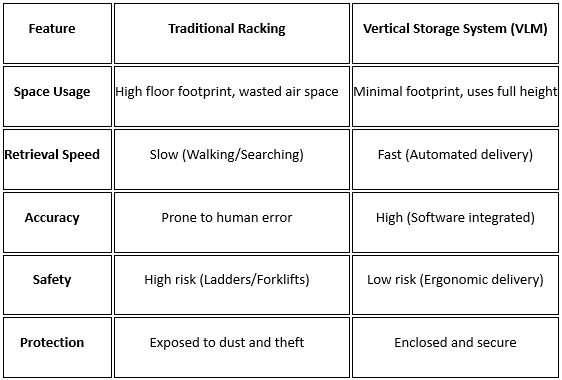
ASRS vs Manual Warehouse: Cost Comparison
| Factor | Manual Warehouse | ASRS System |
| Labour Cost | High | Low |
| Accuracy | 90–95% | 99.9% |
| Speed | Moderate | High |
| Space Utilisation | Limited | Maximum |
| Scalability | Difficult | Easy |
This comparison clearly demonstrates why ASRS adoption is increasing across industries in India.
Additional Benefits of Warehouse Automation
-> Improved Safety
Automated systems reduce manual handling, lowering the risk of workplace injuries and associated costs.
-> Real-Time Inventory Tracking
ASRS enables automated inventory management, eliminating manual stock counting and improving accuracy.
-> Better Workforce Utilisation
Employees can focus on higher-value tasks rather than repetitive manual activities.
ROI of ASRS System in India
One of the key considerations for businesses is the return on investment.
Typical ROI Timeline:
2.5 to 4 years
Factors Driving Faster ROI in India:
- Rising labour costs
- Expansion of e-commerce and logistics sectors
- GST-driven warehouse consolidation
- Demand for faster and accurate order fulfilment
Investing in warehouse automation ensures long-term cost savings and scalability.
Is ASRS Suitable for Your Business?
ASRS is ideal for:
- Manufacturing companies
- Third-party logistics (3PL) providers
- E-commerce fulfilment centres
- Warehouses with high SKU volumes
If your goal is to reduce manpower, improve efficiency, and scale operations, ASRS is a strategic investment.
Why Choose Techmark Storage
Techmark Storage specialises in advanced warehouse automation solutions designed to improve efficiency and reduce operational costs.
Our ASRS solutions help businesses:
- Reduce warehouse labour costs by up to 40%
- Improve picking speed and accuracy
- Maximise storage space
- Achieve faster return on investment
To discuss your requirements or get a customised solution, visit us
Conclusion
The adoption of ASRS systems in India is rapidly increasing as businesses look for smarter and more efficient warehousing solutions.
By implementing ASRS, companies can:
- Reduce operational costs
- Improve productivity
- Enhance accuracy and scalability
Warehouse automation is no longer optional—it is essential for building a future-ready supply chain.
People Also Ask
Heavy-duty racks are used to store heavy, bulky, or high-volume materials in warehouses, factories, and industrial facilities.
They improve storage capacity, organization, safety, and warehouse efficiency while supporting high load requirements.
Bolt-free racks are easier to install, adjust, and reconfigure, making them more flexible for changing storage needs.
Manufacturing, automotive, pharma, logistics, engineering, retail, and FMCG industries commonly use heavy-duty racks.
They make better use of vertical space and help organize materials efficiently, allowing more storage in the same footprint.