
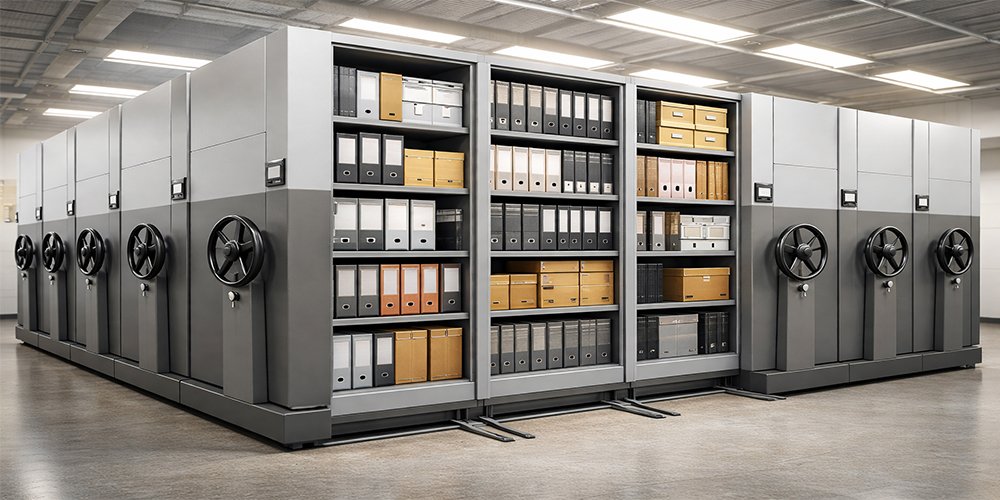
Maximizing Every Square Foot: The Ultimate Guide to Mobile Compactor Storage Systems

Maximizing Every Square Foot: The Ultimate Guide to Mobile Compactor Storage Systems
In the modern business landscape, space is more than just a physical dimension—it is a significant overhead cost. Whether you are managing a high-end law firm in a skyscraper or a massive distribution centre, the "real estate" within your four walls is precious.
Enter Mobile Compactor Storage Systems. Often referred to as rolling racks or high-density mobile shelving, these systems is the gold standard for businesses looking to double their storage capacity without knocking down a single wall.
What is a Mobile Compactor Storage System?
At its core, a mobile compactor system consists of shelving or racking units mounted on wheeled bases that move along floor tracks.
Unlike traditional static shelving, which requires a fixed aisle between every single row, mobile compactors eliminate unnecessary aisles. By "compacting" the units together, you only need one moving aisle to access your items. When you need a specific file or product, you simply move the units to open an aisle exactly where you need it.
How It Works: Step-by-Step Mechanics
Understanding the mechanics helps in choosing the right system for your specific industry needs.
1. The Track System
The foundation of any compactor is the rail. These are precision-engineered tracks installed into or onto the floor. High-quality systems use leveled steel tracks to ensure the heavy carriages move smoothly without friction.
2. The Mobile Carriage
The "carriage" is the wheeled base that sits on the tracks. This is the heavy-duty component responsible for supporting the weight of the shelving and the stored goods.
3. The Drive Mechanism
There are three primary ways to move these systems:
- Manual: You physically pull a handle to slide the unit. (Best for small, light applications).
- Mechanical Assist: You turn a geared "steering wheel" (rotary handle). This allows a single person to move thousands of pounds with minimal effort.
- Powered/Electric: A simple push of a button or a touchscreen command moves the units. These often include safety sensors and "soft-start" technology.
4. Locking and Security
Most systems come with centralized locking. Since the units can be pushed together and locked, they act as their own "vault," protecting sensitive documents or high-value inventory from unauthorized access.
Industry-Specific Applications
Mobile compactors are chameleon-like in their utility. Here is how different sectors utilize them:
Healthcare & Pharmaceuticals
Hospitals use them to store patient records, bulk scrubs, and pharmaceutical supplies. In labs, they house temperature-sensitive samples in a condensed footprint, reducing the energy needed to keep the area climate-controlled.
Corporate & Legal
Law firms and accounting office’s deal with massive volumes of "dead files" that must be kept for years for compliance. Compactor systems allow these firms to stay in smaller, prestigious downtown offices rather than moving to a larger space just to house paper.
Industrial & Warehousing
In a warehouse, these are often called Mobile Pallet Racking. Instead of light shelving, these systems hold massive pallets. They are game-changers for cold storage facilities where every cubic meter of refrigerated air is expensive.
Museums & Libraries
For archival storage, mobile systems provide "museum-grade" protection. They can be fitted with specialized drawers for artefact’s or extra-wide shelves for rare books, ensuring items are stored in a dust-free, condensed environment.
Key Benefits for Your Business
- 50% Space Savings: You can typically store the same amount of material in half the floor space.
- Increased Productivity: By centralizing storage, employees spend less time walking across large warehouses or office floors to find items.
- Cost Avoidance: The cost of installing a compactor system is almost always lower than the cost of a building expansion or a long-term lease on a larger facility.
- Improved Organization: Because these systems are modular, they force a level of "inventory discipline" that often results in better labeling and tracking
Step-by-Step Implementation Guide
If you are considering a transition to mobile storage, follow this roadmap:
- Step 1: The Needs Audit
- Analyse what you are storing. Is it heavy (parts), light (files), or awkward (art)? Calculate the linear feet of storage you currently use and your projected growth over the next 5 years.
- Step 2: Floor Load Capacity Assessment
- Because mobile compactors concentrate a lot of weight into a small area, you must verify that your floor can handle the "point load." A structural engineer or the system provider should assist with this.
- Step 3: Configuration Design
- Decide on the drive mechanism (Manual vs. Electric) and the shelving type. You can choose from wire shelving, solid steel, or even bin-based systems for small parts.
- Step 4: Installation
- Professional installation is non-negotiable. The tracks must be perfectly level. Even a 1-degree tilt can cause carriages to drift or put undue strain on the motor.
Why Experience Matters: The Techmark Storage Advantage
Choosing a storage partner isn’t just about buying metal shelves; it’s about investing in precision engineering and long-term reliability. At Techmark Storage, we have been at the forefront of the storage revolution since 1999. With over two decades of experience, we have seen industries evolve, and we’ve evolved right alongside them.
We don’t just move racks; we specialize in advanced Control & Automation Solutions that turn static warehouses into smart, high-performance hubs. Whether you are looking for a simple mechanical-assist system or a fully automated, sensor-driven storage environment, our tenure in the market ensures that your installation is seamless, safe, and built to last.
Why Partner with Techmark Storage?
- Decades of Expertise: 25+ years of solving complex spatial challenges across every industry imaginable.
- Custom Automation: Tailored control systems that integrate with your specific workflow.
- Industry-Leading Safety: Our automated solutions prioritize operator protection and inventory integrity.
- End-to-End Support: From the first floor-load calculation to the final safety certification.
Don’t let expensive square footage go to waste. Experience the difference that professional automation and decades of “know-how” can make for your bottom line.
Ready to Optimize Your Space?
Stop guessing and start growing. Contact Techmark Storage today for a free quotation and expert consultation. Let’s design a better, smarter storage solution together.
Frequently Asked Questions (FAQ)
Yes. Modern mechanical and electric systems include safety sweeps and infrared sensors. If a person or an object is in an aisle while it’s closing, the system stops instantly.
Often, yes. Many mobile carriages are designed to be "universal," meaning you can mount your current static shelving onto the new mobile bases to save on costs
Very little. A bi-annual check of the tracks to ensure they are clear of debris and a quick lubrication of the chains/gears is usually all that’s needed
Not at all. Due to high-performance gearing, a person can typically move 10,000 lbs of weight with just one finger on the handle..