The Ultimate Battle of Dense Storage: Heavy-Duty Racks vs. Mobile Compactors

The Ultimate Battle of Dense Storage: Heavy-Duty Racks vs. Mobile Compactors
Managing an industrial facility means battling a constant challenge: skyrocketing real estate costs vs. growing inventory volumes. If your warehouse floor is overcrowded, you don’t necessarily need to move to a larger facility. You just need to change how you use your vertical and horizontal footprint.
For businesses looking for high-density warehouse storage solutions without immediately investing in fully robotic automation, two primary physical options stand out: Heavy Duty Racks and Mobile Compactors.
Both choices optimise space, but they solve entirely different operational challenges. Let’s look at how they compare to help you choose the right system for your facility.
Understanding the Contenders
- 1. Heavy Duty Racks: The Structural Backbone
- Best For: High-SKU diversity, fast-moving consumer goods (FMCG), automotive components, and operations requiring 100% immediate accessibility to every item.
- 2. Mobile Compactors: The Space Maximiser
- Best For: Cold storage facilities, high-value archival storage, tool/die inventory, and environments where maximising storage density is more critical than rapid throughput.
Space Utilisation vs. Throughput Speed
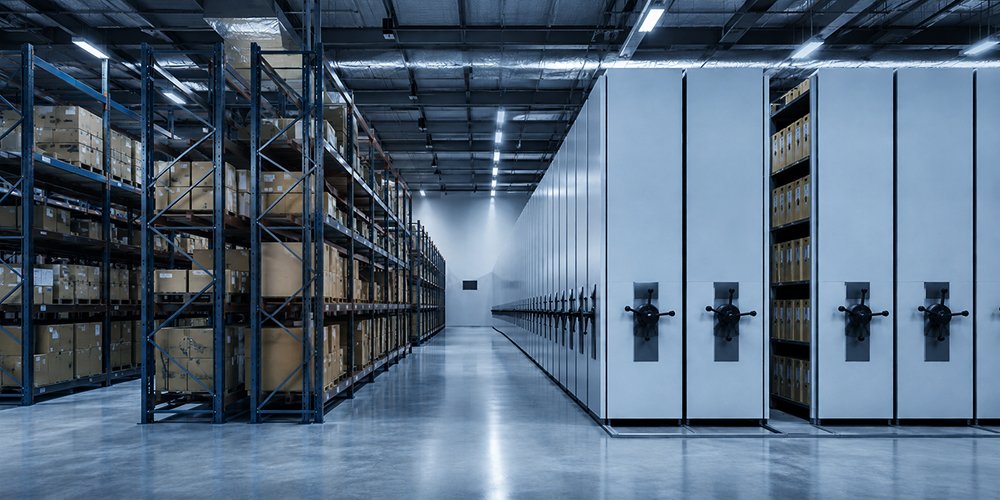
Heavy-duty industrial racking gives your material handling equipment immediate access to any pallet at any time. However, because each row needs its own forklift aisle, up to 60% of your total warehouse floor space can end up underutilised.
Mobile compactors consolidate those separate aisles into a single moving aisle. This design lets you store up to 80% more material within the same footprint, making it one of the most effective structural storage setups available today.
Maintenance and Structural Durability
Tech Mark’s heavy-duty shelving configurations use a boltless design, which reduces wear and makes it easy to adjust shelf heights as your inventory dimensions evolve. On the other side, our mobile compactors use heavy-duty, low-maintenance “Easy Glide” track designs. These tracks are engineered to handle tons of weight smoothly, preventing track deformation even under continuous manufacturing shifts.
The Hybrid Strategy: Many smart manufacturing facilities use a combined layout. They place fast-moving raw materials on selective heavy-duty racks near the production line and keep heavy tools, dies, and spare parts in mobile compactors.
The Verdict: Which System Wins Your Floor?
- Choose Heavy-Duty Racks if: You manage high-turnover logistics, need multiple forklifts picking stock at the same time, and want a simple, budget-friendly setup that grows easily.
- Choose Mobile Compactors if: Your real estate costs are high, you need to store heavy or high-density items efficiently, and maximising your total storage capacity is your top operational priority.
Partner with India’s Storage Engineering Experts
As an ISO 9001 and CE-certified manufacturer, Tech Mark designs, manufactures, and installs durable physical storage systems built for tough industrial use. Whether you need an optimised heavy-duty setup or a high-density mobile compactor system, our engineering team will build a custom layout tailored to your specific facility.